Technology Review details the source of blast injury to the brain. This follows three pathways so simply dealing with one hasn't got the desired effect. The article also deals with the usefulness of knowing how to wound but not kill in a military situation.
Thursday, February 10, 2011
The Macabre Science Of Blast-Induced Brain Injury - Technology Review
The Macabre Science Of Blast-Induced Brain Injury - Technology Review


Friday, September 03, 2010
Future Weapons: Fire Scout UAV
Fired Scout is one of the Navy's new UAV's It can fly a pre-programmed mission initiated with a push of the button.
This weapon is the one that went out of control over restricted areas in Washington recently. Slate Magazine had an article on drones that mention this event. The Slate article brings up war crimes in connection with UAV's. Of course that is a possibility.
The U.S. government runs two drone programs. The military’s version, which is publicly acknowledged, operates in the recognized war zones of Afghanistan and Iraq, and targets enemies of U.S. troops stationed there. As such, it is an extension of conventional warfare. The C.I.A.’s program is aimed at terror suspects around the world, including in countries where U.S. troops are not based. It was initiated by the Bush Administration and, according to Juan Zarate, a counterterrorism adviser in the Bush White House, Obama has left in place virtually all the key personnel. The program is classified as covert, and the intelligence agency declines to provide any information to the public about where it operates, how it selects targets, who is in charge, or how many people have been killed
Read more http://www.newyorker.com/reporting/2009/10/26/091026fa_fact_mayer#ixzz0yTl3iVxg
According to the New Yorker article
Peter Bergen and Katherine Tiedemann, report that the Obama Administration has sanctioned at least forty-one C.I.A. missile strikes in Pakistan since taking office—a rate of approximately one bombing a week. So far this year, various estimates suggest, the C.I.A. attacks have killed between three hundred and twenty-six and five hundred and thirty-eight people. Critics say that many of the victims have been innocent bystanders, including children.
Read more http://www.newyorker.com/reporting/2009/10/26/091026fa_fact_mayer#ixzz0yTmhTgjn
The article goes on to discuss how targeting algorithms work and difficulties in their implementation. Israel has considerable experience in this type of action. Part of its targeting procedure includes a lawyer and an expert in arab culture.
It appears that UAV's require a good deal of thought in their targeting and use, and that that thought has not been up to par so far
Thursday, February 11, 2010
Darpa's Immortal Cells
As part of its budget for the next year, Darpa is investing $6 million into a project called BioDesign, with the goal of eliminating “the randomness of natural evolutionary advancement.” The plan would assemble the latest bio-tech knowledge to come up with living, breathing creatures that are genetically engineered to “produce the intended biological effect.” Darpa wants the organisms to be fortified with molecules that bolster cell resistance to death, so that the lab-monsters can “ultimately be programmed to live indefinitely.”
Read More http://www.wired.com/dangerroom/2010/02/pentagon-looks-to-breed-immortal-synthetic-organisms-molecular-kill-switch-included/#ixzz0fFeMRbZr
Read More http://www.wired.com/dangerroom/2010/02/pentagon-looks-to-breed-immortal-synthetic-organisms-molecular-kill-switch-included/#ixzz0fFeMRbZr
Monday, December 28, 2009
"Sea Fighter" The X-Craft was designed to demonstrate to the US and other navies the versatility of a very high speed, high payload capability vessel which can cross oceans quickly, and operate in shallow coastal waters on missions which include mine counter measures and antisubmarine warfare. The Littoral Surface Craft-Experimental LSC(X) was developed by the Office of Naval Research and christened Fast Sea Frame Sea Fighter (FSF 1) on 5 February 2005. The X-Craft transformational program is a high-speed, aluminum catamaran consisting of an advanced hull geometry, designed to give the craft speeds of 50 knots or more. Initially, she will be used by ONR for purposes of hydrodynamic experimentation and as a test bed for Hull, Mechanical, and Electrical (HME) concepts for the Navy's new class of warship, Littoral Combat Ship (LCS). X-Craft is the first vessel that the Navy has designed specifically as a “sea frame,” decoupling hull, mechanical and electrical (HM&E) systems from the mission packages and allowing for a true “plug and fight” mission module capability. Mission flexibility will be demonstrated through interchangeable “mission modules” (standard twenty-foot containers) housed in the X-Craft’s large mission bay. The mission bay will hold up to twelve containers, each with its own dedicated service panel, permitting rapid reconfiguration of the vessel to support a variety of potential missions including battle force protection, mine countermeasures, anti-submarine warfare, amphibious assault support, and logistics/humanitarian support.
Wednesday, August 05, 2009
Was Rummy Really Wrong? | The LA Progressive
Was Rummy Really Wrong? The LA Progressive
Is Military Transformation dead? This article says that it has uses against a conventional, major power. Somehow, I think the article misses the point. Military Transformation is not focused on specific missions alone. It is a state of mind. Iraq worked well in the initial phases. (this has nothing to do with our need to go there for the right reasons). The military simply had no plan for a successful occupation. The radical ideas of transformation could have been applied there, but the entire bullet seems to have been missed in the planning.
Is Military Transformation dead? This article says that it has uses against a conventional, major power. Somehow, I think the article misses the point. Military Transformation is not focused on specific missions alone. It is a state of mind. Iraq worked well in the initial phases. (this has nothing to do with our need to go there for the right reasons). The military simply had no plan for a successful occupation. The radical ideas of transformation could have been applied there, but the entire bullet seems to have been missed in the planning.
Tuesday, January 13, 2009
Winslow T. Wheeler, Director, Straus Military Reform Project, Center for Defense Information
Says real reform starts with at least three principles:
1. No failed system can be fixed if it cannot be accurately measured. A crash program to make Pentagon spending accountable is essential. But just that is also insufficient. DOD must also have an ability to predict with reasonable accuracy the cost, performance, and schedule of its future programs and policies. The current bias, based on advocacy, is the heart and core of business as usual.
2. The basis for competence cannot just be intelligence and hard work; it must also be objectivity and independence, ruthlessly enforced. We currently have a fundamentally corrupt incentive system for senior Pentagon decision-makers. The iron-clad control of the Pentagon decision process by people (in and out of uniform) who are free to then collect salaries and other emoluments from defense contractors (or other organizations, frequently lobbying firms and think tanks, funded by them) must end - without compromise. The similar sham of members of Congress and - especially - their staff pretending to perform oversight on Capitol Hill and then accepting jobs from those they "oversee" (including the Pentagon) must also end.
3. If ever the above two principles are observed, President Obama can very usefully review all existing hardware programs. We need a process where well informed, independently minded Pentagon managers can actually identify the unaffordable, the irrelevant, and the impractical hardware programs combined with an atmosphere where people appreciate that the money party in Washington is over.
Tags: Pentagon Reform
Powered by Qumana
New Missiles in Opposition to the US Navy
Some of the old names are disappearing from the list of modern missle weapons. Read the article to see what has changed.
Powered by Qumana
Thursday, December 18, 2008
Laser Weapons on the Horizon
A megawatt laser weapon was fired from an aircraft for the first time.Although the Airborne Laser (ABL) was fired from a stationary plane at a target on the ground just a few metres away, the test marked a milestone for the weapon, developed by aerospace firms Boeing, Lockheed Martin and Northrop Grumman.The laser was 12 years in the making and cost $4.3 billion, putting it vastly over budget.
Some laser weapons are already being used by the military. In Iraq and Afghanistan a laser system called Zeus, developed by the US navy, is being tested by coalition forces for detonating the improvised explosive devices of insurgents. The 10-kilowatt laser is pointed at the device from a few hundred metres away, to heat the explosive until it detonates. It can take between 4 seconds to 15 minutes to destroy an explosive device - but the advantage is that no soldiers' lives are risked. And last month Northrop Grumman launched Firestrike, an electrically powered 15-kilowatt battlefield laser that can be multiplied in power by adding more units.
I have followed the ABL system for years. It appears to finally be here. I was surprised by some of the other laser weapons mentionned.
Tags: ABL, Laser Weapons, Zeus, Firestrike
Powered by Qumana
The U.S. Defense Department has awarded its up to three-year, $300 million contract for "information operations" in Iraq and possibly Afghanistan. There are four lucky firms: the Lincoln Group, which was outed in 2005 for planting U.S. military-written pieces in Iraqi newspapers; Leonie Industries, a woman-owned company that promises "access to seemingly impenetrable markets" around the world; SOS International, which in 2006 won a contract to monitor foreign media for coverage of the so-called Global War on Terrorism; and MPRI, a unit of L-3 Communications that won a contract in 2003 to involve former Iraqi soldiers in public works projects. The new PR push is "seen by the [U.S.] military as a means toward 'reconciliation' of the country and a way to foster support for Iraqi Security Forces from Iraqi civilians," reports O'Dwyer's.
This is an example of the Admin function in Barnett's book, Pentagon's New Map.
Powered by Qumana
Monday, December 08, 2008

Unmanned Aerial Vehicles (UAVs)
Unmanned Aerial Vehicles (UAVs) are remotely piloted or self-piloted aircraft that can carry cameras, sensors, communications equipment or other payloads. They have been used in a reconnaissance and intelligence-gathering role since the 1950s, and more challenging roles are envisioned, including combat missions. Since 1964 the Defense Department has developed 11 different UAVs, though due to acquisition and development problems only 3 entered production. The US Navy has studyied the feasibility of operating VTOL UAVs since the early 1960s, the QH-50 Gyrodyne torpedo-delivery drone being an early example. However, high cost and technological immaturity have precluded acquiring and fielding operational VTOL UAV systems.
By the early 1990s DOD sought UAVs to satisfy surveillance requirements in Close Range, Short Range or Endurance categories. Close Range was defined to be within 50 kilometers, Short Range was defined as within 200 kilometers and Endurance as anything beyond. By the late 1990s, the Close and Short Range categories were combined, and a separate Shipboard category emerged. The current classes of these vehicles are the Tactical UAV and the Endurance category.
Pioneer: Procured beginning in 1985 as an interim UAV capability to provide imagery intelligence for tactical commanders on land and see at ranges out to 185 kilometers. No longer in the Army inventory (returned to the US Navy in 1995).
Tactical UAV : Designed to support tactical commanders with near-real-time imagery intelligence at ranges up to 200 kilometers. Outrider Advanced Concept Technology Demonstration (ACTD) program terminated. Material solution for TUAV requirements is being pursued through a competive acquisition process with goal of contract award in DEC 99.
Joint Tactical UAV (Hunter): Developed to provide ground and maritime forces with near-real-time imagery intelligence at ranges up to 200 kilometers; extensible to 300+ kilometers by using another Hunter UAV as an airborne relay. Training base located at Fort Huachuca, with additional baseline at Fort Polk to support JRTC rotations. Operational assets based at Fort Hood (currently supporting the KFOR in Kosovo).
Medium Altitude Endurance UAV (Predator): Advanced Concept Technology Demonstration now transitioned to Low-Rate Initial Production (LRIP). Provides imagery intelligence to satisfy Joint Task Force and Theater Commanders at ranges out to 500 nautical miles. No longer in the Army inventory (transferred to the US Air Force in 1996).
High Altitude Endurance UAV (Global Hawk): Intended for missions requiring long-range deployment and wide-area surveillance (EO/IR and SAR) or long sensor dwell over the target area. Directly deployable from CONUS to the theater of operations. Advanced Concept Technology Demonstration (ACTD) managed by the US Air Force.
Tactical Control Station (TCS): The Tactical Control Station is the software and communications links required to control the TUAV, MAE-UAV, and other future tactical UAV's. It also provides connectivity to other C4I systems.
Micro Unmanned Aerial Vehicles (MAV): DARPA program to explore the military relevance of Micro Air Vehicles for future military operations, and to develop and demonstrate flight enabling technologies for very small aircraft (less than 15cm/6in. in any dimension).
| Unmanned Aerial Vehicle Name | Endurance (Hours) | Payload Weight (Pounds) | Altitude Capability (Feet) | STATUS |
| AQM-34N Firebee | hr. | lbs. | ft. | |
| Aquila | hr. | lbs. | ft. | |
| Arcturus T-16 | 16 hr. | 20 lbs. | 17,000 ft. (gas) - 40,000 ft. (electric) | |
| COMPASS ARROW | hr. | lbs. | ft. | |
| COMPASS BIN | hr. | lbs. | ft. | |
| COMPASS COPE | hr. | lbs. | ft. | |
| COMPASS DAWN | hr. | lbs. | ft. | |
| Condor | hr. | lbs. | ft. | |
| CR-TUAV | hr. | lbs. | ft. | |
| CR-UAV | hr. | lbs. | ft. | |
| Darkstar | 8 hrs. | 1,000 lbs. | 45,000 ft. | |
| Dragon | hr. | lbs. | ft. | |
| Eagle Eye | 8 hrs. | 300 lbs. | 20,000 ft. | |
| Exdrone | 2.5 hr. | 25 lbs | 10,000 ft. | |
| Firebee | 1.25 hrs. | 470 lbs. | 60,000 ft. | |
| Global Hawk | 42 hrs. | 1,960 lbs. | 65,000 ft. | |
| Gnat 750 | 48 hrs. | 140 lbs. | 25,000 ft. | |
| Hunter | 12 hrs. | 200 lbs. | 15,000 ft. | |
| Model 324 | 2.5 hrs. | 200 lbs. | 43,000 ft. | |
| Model 410 | 12 hrs. | 300 lbs. | 30,000 ft. | |
| MR-UAV | hr. | lbs. | ft. | |
| MRE | hr. | lbs. | ft. | |
| Outrider | 4 hrs. | 160 lbs. | 15,000 ft. | |
| Pioneer | 5.5 hrs. | 75 lbs. | 12,000 ft. | |
| Pointer | 1 hr. | 2 lbs. | 3,000 ft. | |
| Predator | 29 hrs. | 700 lbs. | +40,000 ft. | |
| SEA FERRET | hr. | lbs. | ft. | |
| SENIOR BOWL [D-21] | hr. | lbs. | ft. | |
| VT-UAV | hr. | lbs. | ft. | |
| VT-UAV Dragonfly | hr. | lbs. | ft. | |
| VT-UAV Vigilante | hr. | lbs. | ft. | |
| VT-UAV Guardian | hr. | lbs. | ft. | |
| MQ-8B Army Fire Scout | hr. | lbs. | ft. | |
| MQ-8B Navy Fire Scout | hr. | lbs. | ft. |
Tags: UAV
Powered by Qumana
Active Protection System (APS)
The U.S. Army is developing Active Protection System (APS) as part of its Future Combat Systems ground-force modernization program. FCS is designed to bring Soldiers into the 21st century by equipping them with state-of-the-art vehicles, communication capabilities, sensors and protective systems. The system has been named one of the best inventions of 2008 by Time magazine.
Tags: APS, FCS, Active Protection System
Powered by Qumana
Wednesday, November 26, 2008
Thai Trawler sunk by INS Ship
The Indian navy error in sinking a Thai trawler in the last week shows the problem that exists with information, either too much or too little of it, in dealing with non-state actors like pirates.
The ship seems to be under pirate control and to have attacked the frigate that sank it. The issue is the death of the hostages on the ship. In former centuries, their deaths would not be well know and the removal of the pirate force on the ship would have been positive for stopping piracy. In these times, the ideal use of force must be more surgical. So, our multi-billion dollar navies are tied up by bandits with RPG's.
Link
The ship seems to be under pirate control and to have attacked the frigate that sank it. The issue is the death of the hostages on the ship. In former centuries, their deaths would not be well know and the removal of the pirate force on the ship would have been positive for stopping piracy. In these times, the ideal use of force must be more surgical. So, our multi-billion dollar navies are tied up by bandits with RPG's.
Link
Wednesday, November 19, 2008
Blackwater beats the Navy or maybe it is Democracy
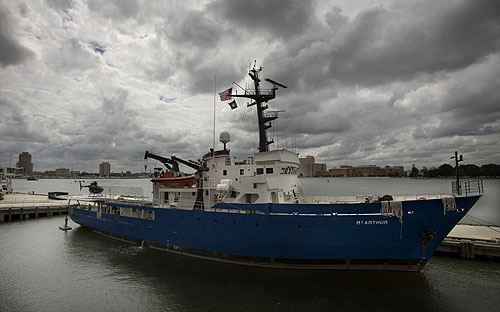
Blackwater is offering the MV MacArthur, a 183-foot vessel with a crew of 14 and a helicopter pad, as an escort for ships through the Gulf of Aden.
“We have the capability to assist” shipping companies, said Bill Mathews, Blackwater executive vice president. He and other company leaders are former Navy SEALs. Ship security “is kind of what we did for a living” before joining Blackwater, he said.
link
The company isn’t seeking new U.S. security contracts in Iraq, where a Blackwater team was involved in the killing of 17 Iraqi civilians while guarding a State Department convoy in September 2007. The deaths are being investigated by the Federal Bureau of Investigation.
The State Department paid Blackwater more than $832 million to provide security between 2004 and 2006, about half of the money under a no-bid contract awarded in June 2004.
According to Coast Guard records, the McArthur was decommissioned by the National Oceanic and Atmospheric Administration in 2003 after nearly 40 years as a research vessel. Built in 1966 by Norfolk Shipbuilding & Drydock Co., now BAE Systems Norfolk Ship
Tags: MV MacArthur
Tags: Blackwater, US Navy, Samilia, Pirates
Isn't it amazing that in the picture above this ship is flying the American flag. It is another example of some American citizens having the right to wage war outside of government channels. Blackwater is a private army with land, sea and air forces operating out of the United States. That should not be allowed.
Powered by Qumana
Wednesday, November 12, 2008
Russians to have Six New Aircraft Carriers by 2025
NLOS-C is the lead prototype in the Army's family of eight FCS Manned Ground Vehicles (MGVs). The new cannon implements automated ammunition loading system and improved accuracy through on-board projectile tracking coupled with the power of the FCS network and sensors. It is operated by a crew of two soldiers. "This marks the first 155mm round fired from a fully automated howitzer mounted on an FCS hybrid-electric chassis and remotely commanded through its on-board computers and controls," stated Lieutenant Colonel Robert McVay, Army Product Manager for NLOS-C.
It will be one of nine vehicles to be produced under the system development phase. As the system is approved for operational testing, more vehicles will be produced for the testing, overall, the Army's Evaluation Task Force (AETF) will receive 18 NLOS-C platforms starting in 2010. The AETF will put the NLOS-C through combat scenarios to provide lessons learned that will be used to enhance and finalize the design for the final production NLOS-Cs and the rest of the MGV family.
NLOS-C is the lead prototype in the Army's family of eight FCS Manned Ground Vehicles (MGVs). The new cannon implements automated ammunition loading system and improved accuracy through on-board projectile tracking coupled with the power of the FCS network and sensors. It is operated by a crew of two soldiers. "This marks the first 155mm round fired from a fully automated howitzer mounted on an FCS hybrid-electric chassis and remotely commanded through its on-board computers and controls," stated Lieutenant Colonel Robert McVay, Army Product Manager for NLOS-C.
It will be one of nine vehicles to be produced under the system development phase. As the system is approved for operational testing, more vehicles will be produced for the testing, overall, the Army's Evaluation Task Force (AETF) will receive 18 NLOS-C platforms starting in 2010. The AETF will put the NLOS-C through combat scenarios to provide lessons learned that will be used to enhance and finalize the design for the final production NLOS-Cs and the rest of the MGV family.
August 08, 2008: Speaking to journalists on the occasion of the Russian Navy Day celebrations, the commander of the Russian Navy, Admiral Vladimir Visotskiy confirmed the the Russian Navy is planning to deploy six aircraft-carrier groups with its Northern and Pacific fleets. They will be operated within a new, network-centric task groups, closely integrated with Russian air force and air-defense assets via Russia’s military-satellite network. (more...)
Tags: Russian Carriers
Adm. Visotskiy indicated that six new aircraft carriers and all the necessary support ships will be built to sustain this momentum. Construction of the first aircraft carrier is expected to begin in 2012. The six groups could be fully deployed by 2025.
At present, the Russians operate only a single aircraft carrier Admiral Kuznetsov with the Northern Fleet. Moscow have yet to decide where to build these vessels, as the only facility capable of such scale of work is located in the Nikolayev Shipyard on the Black Sea in the Ukraine.
In the mid 1980s the Russian Navy launched three Type 1143.5 carriers, Admiral Kuznetsov, and Varyag which was delivered as scrap to China. The third carrier, Admiral Gorshkov is being refurbished for the Indian Navy, to be fielded by 2013. Only one aircraft carrier remained in Russian service - the Admiral Kuznetsov. The vessel, carries 12 fixed wing aircraft, including Su-33 fighters and Su-25 attack aircraft as well as various types of Ka-27 special mission helicopters (AEW, ASW, SAR).
Addressing the construction of Borei class nuclear-powered missile carrying submarines, the Admiral said the Navy plans to modernize at least one Borei-class strategic nuclear submarine which is considered to be the mainstay of the naval component of Russia’s strategic nuclear forces until 2040. Three vessels of this class are currently in construction at the Sevmash shipyard in Severodvinsk, in the Arkhangelsk region. However, but their completion has been delayed by test failures of the Bulava ballistic missile, its main weapon. Adm. Visotskiy said the first three submarines would be commissioned without significant changes to the initial design, but the fourth will undergo upgrades.

Powered by Qumana
NLOS-C Fires First Round

NLOS-C is the lead prototype in the Army's family of eight FCS Manned Ground Vehicles (MGVs). The new cannon implements automated ammunition loading system and improved accuracy through on-board projectile tracking coupled with the power of the FCS network and sensors. It is operated by a crew of two soldiers. "This marks the first 155mm round fired from a fully automated howitzer mounted on an FCS hybrid-electric chassis and remotely commanded through its on-board computers and controls," stated Lieutenant Colonel Robert McVay, Army Product Manager for NLOS-C.
It will be one of nine vehicles to be produced under the system development phase. As the system is approved for operational testing, more vehicles will be produced for the testing, overall, the Army's Evaluation Task Force (AETF) will receive 18 NLOS-C platforms starting in 2010. The AETF will put the NLOS-C through combat scenarios to provide lessons learned that will be used to enhance and finalize the design for the final production NLOS-Cs and the rest of the MGV family.
Powered by Qumana
Thursday, August 21, 2008
Battle of the Wabash - Wikipedia, the free encyclopedia
Battle of the Wabash
From Wikipedia, the free encyclopedia
Jump to: navigation, search
The 1811 Battle of Tippecanoe was also once known as the Battle of the Wabash.
Battle of the Wabash
Part of the Northwest Indian War
Date
November 4, 1791Location
near present-day Fort Recovery, OhioResult
Overwhelming Native American victoryBelligerents
Western Confederacy
United StatesCommanders
Little Turtle,
Blue Jacket,
Buckongahelas
Arthur St. Clair,
Richard Butler †Strength
1000
1000Casualties and losses
21 killed and 40 wounded
total: 61
623 soldiers killed or captured
258 soldiers wounded
24 workers killed,
14 wounded
33 women killed
total:952[hide]
Logan's Raid – Hardin's Defeat – Harmar's Defeat – Big Bottom – Dunlap's Station – St. Clair's Defeat – Fort Recovery – Fallen Timbers
The Battle of the Wabash, also known as St. Clair's Defeat and the Battle of Wabash River, was fought on November 4, 1791, in the Northwest Territory between the United States and the Western Confederacy of American Indians, as part of the Northwest Indian War. It was a major Native American victory.
The American Indians were led by Little Turtle of the Miamis, Blue Jacket of the Shawnees, and Buckongahelas of the Delawares (Lenape), who led his 480 men to join the 700 warriors of Little Turtle and Blue Jacket. In comparison, the opposing force of about 1000 Americans were led by General Arthur St. Clair who had proved to be an able commander during the American Revolutionary War. However, the Indian confederacy eventually was victorious. The battle was the most severe defeat ever suffered by the United States at the hands of American Indians; indeed, in proportional terms of losses to strength it was the worst defeat that United States forces have ever suffered in battle. As a result, President George Washington forced St. Clair to resign his post, and Congress initiated its first investigation of the executive branch. Of the 1,000 troops that Saint Clair led into battle, only 48 escaped.
Contents
[show][edit] Background
The Treaty of Paris of 1783, which ended the War of American Independence, recognized United States sovereignty of all the land east of the Mississippi River and south of the Great Lakes. The Indian tribes in the Old Northwest, however, were not parties to this treaty, and many of them, especially leaders such as Little Turtle and Blue Jacket, refused to recognize American claims to the area northwest of the Ohio River. During the mid- and late 1780s, white settlers in Kentucky and travelers on and north of the river suffered approximately 1500 deaths during the ongoing hostilities, in which white settlers often retaliated against Indians. As a result of the continual violence, President Washington and his Secretary of War, Henry Knox, decided to use military force to pacify the region.
A force of 1,453 men (320 Regular U.S. Troops and 1,133 militia) under Brigadier General Josiah Harmar marched northwards from Fort Washington on the Ohio River at 10:00 a.m. on October 7, 1790. On October 22, near present-day Fort Wayne, Indiana, Harmar committed only 400 of his men under Col. John Hardin to attack an Indian force of some 1,100 warriors. When a courier informed Harmar (rumored to be drunk) of the size of the enemy force, out of fear he refused to come to Hardin's aid. Had he supported Colonel Hardin with the other 800-900 men, the Indian force might have been defeated. Instead, Harmar formed his portion of the army into a hollow defensive square, and did not move. Hardin, expecting reinforcements, put up a valiant fight for over three hours, then fell back to the main army's encampment and Harmar ordered a retreat back to Ft. Washington. (See main article: Hardin's Defeat).
At least 129 of Hardin's troops (14 officers, 115 enlisted) were killed in action and another 94 wounded, for a total of 223 casualties. Estimates of total Indian casualties, killed and wounded, range from 120 to 150. George Washington then ordered St. Clair, who served both as governor of the Northwest Territory and as a major general in the army, to mount a more vigorous effort by summer 1791. Congress agreed to fund the expedition as well as to authorize the raising of an additional U.S. Army regiment for the purpose, bringing the total number of army regiments in existence to just two (the 1st and 2nd American Regiments). St. Clair augmented this force with Kentucky militia as well as five battalions of six-month levies.
[edit] The campaign
While Washington was adamant that St. Clair move north in the summer months, various logistics and supply problems greatly slowed his preparations in Fort Washington (present-day Cincinnati, Ohio). The new recruits were poorly trained and disciplined, the food supplies substandard, and the horses, low in number, were of poor quality. The expedition thus failed to set out until October 1791. Building supply posts as it advanced, the army's objective was the town of Kekionga, the capital of the Miami tribe, near present-day Fort Wayne, Indiana.
When it did get underway, the force, including some 200-250 camp followers (wives, children, laundresses, and prostitutes) numbered around 1,486. Going was slow and discipline problems were severe; St. Clair, suffering from gout, had difficulty maintaining order, especially among the militia and the new levies. The force was constantly shadowed by Indians, and skirmishes occasionally erupted.
By the end of November 2, through desertion and illness, St. Clair's force had been whittled down to around 1,120, including the camp followers. He had 52 officers and 868 enlisted and militia present for duty on November 3. At dawn on November 4, St. Clair's force was camped near the present-day location of Fort Recovery, Ohio. An Indian force consisting of around 1,000 warriors, led by Little Turtle, Blue Jacket, and Tecumseh, struck quickly and, surprising the Americans, soon overran their perimeter. The Americans almost immediately collapsed into disorder. St. Clair had three horses shot out from under him as he tried in vain to rally his troops, many of whom hid beneath wagons and behind trees despite goading from their commander (who at one point moved among them chanting "Cowards, cowards, cowards,") and from female camp followers.
The casualty rate was the highest percentage ever suffered by a United States Army, and included St. Clair's second in command. Of the 52 officers engaged, 39 were killed and 7 wounded, around 88% of all officers became casualties. After two hours, St. Clair ordered a retreat, which quickly turned into a rout. "It was, in fact, a flight," St. Clair described a few days later in a letter to the Secretary of War. The American casualty rate, among the soldiers, was 97.4 percent, including 632 of 920 killed (69%), and 264 wounded. Nearly all of the 200 camp followers were slaughtered, for a total of 832 Americans killed. Approximately one-quarter of the entire standing United States Army had been wiped out. Only 24 of the 920 troops engaged came out of it unscathed. Indian casualties were about 61, with at least 21 killed. The number of soldiers killed alone was more than three times the number the Sioux would kill 85 years later at Custer's last stand at the Little Big Horn. The next day the remnants of the force arrived at the nearest U.S. outpost, Fort Jefferson (then Fort Hamilton) and from there returned to Fort Washington.
- Casualty statistics from "That Dark and Bloody River", by Allan W. Eckert, Bantam Books, December 1995.
[edit] Aftermath
St. Clair himself soon traveled to the national capital at Philadelphia to report on what had happened. Blaming the quartermaster as well as the War Department, the general asked for a court-martial in order to gain exoneration and planned to resign his commission after winning it. Washington, however, denied him the court-martial and forced St. Clair's immediate resignation.
The House of Representatives, meanwhile, began its own investigation into the disaster. This was the first investigation that Congress had ever undertaken, as well as the first investigation of the executive branch, and as part of the proceedings, the House committee in charge of the investigation sought certain documents from the War Department. Knox brought this matter to Washington's attention, and because of the major separation of powers issues involved, the president summoned a meeting of all of his department heads (Knox, Secretary of State Thomas Jefferson, Secretary of the Treasury Alexander Hamilton, and Attorney General Edmund Randolph). This was one of the first meetings of all of these officials together, and some scholars consider this occasion the beginning of the Cabinet.
At this and subsequent meetings, the president and his advisers established, in theory, the concept that the executive branch should refuse to hand over any papers or materials that the public good required them to keep secret, and that at any rate they not hand over any originals. This is the earliest appearance of the doctrine of executive privilege, which later became a major separation of powers issue in matters such as Aaron Burr's treason trial, Watergate, the Iran-Contra affair, and the impeachment of President Bill Clinton. In the end, though, Washington authorized the release of copies of the materials that the committee sought.
The final committee report sided largely with St. Clair, finding that Knox and other War Department officials had done a poor job of raising, equipping, and supplying St. Clair's expedition. Other than issuing these findings, however, neither the committee nor the House of representatives took any further steps, such as recommending impeachment.
In 1794, a new U.S. force under Major General "Mad Anthony" Wayne achieved what St. Clair had not when he decisively defeated the Indians of the Old Northwest at the Battle of Fallen Timbers
[edit] References
- Sugden, John, Blue Jacket: Warrior of the Shawnees. Lincoln and London: University of Nebraska Press, 2000. ISBN 0-8032-4288-3.
- Sword, Wiley, President Washington's Indian War: The Struggle for the Old Northwest, 1790-1795. Norman and London: University of Oklahoma Press, 1985. ISBN 0-8061-1864-4 (hardcover); ISBN 0-8061-2488-1 (paperback).
- Guthman, William H., March to Massacre: A History of the First Seven Years of the United States Army. New York: McGraw-Hill, 1970. ISBN 0-07-025297-1.
[edit] External links
- Officers killed at St. Clair's Defeat
- Wilbur Edel, Kekionga!: The Worst Defeat in the History of the U.S. Army
- St. Clair's Defeat folk song
Retrieved from "http://en.wikipedia.org/wiki/Battle_of_the_Wabash"
Sunday, August 17, 2008
Russian Military Equipment Quality
Algeria plans to return 15 fighter jets to Russia: report
MOSCOW (AFP) - Algeria wants to return 15 fighter jets it bought from Russia because of their poor quality, the Kommersant daily reported on Monday, citing an official from Russia’s state United Aerospace Corporation.
The official said Russia was proposing to take back the MiG-29 jets, which were delivered to Algeria in 2006 and 2007, but only if Algeria bought more modern and expensive planes such as the MiG-29M2 or the MiG-35.
Tags: Mig-29, Russia
Powered by Qumana
Thursday, August 07, 2008
Guardium Autonomous Unmanned Ground Vehicle (UGV)
The Guardium UGV uses the TomCar chassis. The vehicle is equipped with an automated tactical positioning system and can operate autonomously on and off road, at speeds up to 80 km/h. The vehicle can carry a payload of up to 300 kg, including light armor shield to protect vital systems. The UGV can carry a wide variety of sensors, including video and thermal cameras, with auto-target acquisition and capture, sensitive microphone, powerful loudspeakers and two way radio. The vehicle can also be equipped with lethal or less than lethal weapons which can be directed and operated from the Main Control Center (MCC). A fleet of Guardium vehicles can be used as sentries, controlled from the MCC, from where they are launched on routine patrols, ambushes or operating in response to events received from an early warning or perimeter defense system. The MCC is also provided with automatic tactical area definition, by terrain, doctrine and intelligence, which assist in preparation of the operational planning and programming for USVs. Each USV can also be manually controlled by remote control.
Following a successful evaluation in 2005 Guardium was selected by the Israel Defense Forces to operate as part of the border security operations. By May 2008 the IDF received the first batch of Guardium UGVs scheduled to enter fully operational service along the countrie's borders by the year's end. In 2008 Israel's Airport Authority conducted an evaluation of the system as part of possible integration of an autonomous UGV as part of its airport security system.


Guardium Autonomous Unmanned Ground Vehicle (UGV)
Technorati Tags: UGV
Subscribe to:
Posts (Atom)